Archive for category: European

What Child Is This?

The famous Christmas carol, penned in 1865 by English writer William Chatterton Dix on his “death bed” (he later recovered), asks the question “What child is this, who laid to rest, on Mary’s lap is sleeping?” and answers “This is Christ, the King”.  Interspersed in his thoughtful lyrics, set to the tune of the medieval English song Greensleeves, are references to shepherds, angels, ox and ass, incense, gold, and myrrh – familiar figures and objects in a traditional nativity scene (also called a crèche).

Two German children admire a small nativity just as their ancestors have done for generations.

Nativities are very popular during the Christmas season – millions of people have small versions in their own homes (we have six!), and many larger scenes are set up in church parking lots, town squares, library courtyards, and front lawns.  One of our local churches has a crèche display in their community hall with over 100 different nativity scenes from all over the world.

There amongst the red-nosed reindeer and Santa Claus is an illuminated nativity in the yard of our neighbour, known affectionately as Mr. Christmas.

Where did this tradition begin?  Many expect the answer to be Germany because so many of our modern Christmas traditions come from the Germanic world, but in fact the nativity originates in medieval Italy.

Built straight out of the stone, the Greccio Franciscan hermitage is an extraordinary fusion of architecture and nature.  It was here that St. Francis first recreated the Christ birth scene on Christmas Eve, 1223.

In 1223, St. Francis of Assisi was visiting the small village of Greccio.  As Christmas approached, he was struck with the idea of creating a scene to represent the birth of Christ for the people of the village.  This was a novel idea, and as such he requested and was granted permission from the pope to create the first nativity scene, to be displayed during Midnight Mass.  It was a live scene – real baby, real donkey, real hay.  According to his biographer, “St. Francis stood before the manger, full of devotion and piety, bathed in tears and radiant with joy.”  The scene so moved the great monk that he could not bring himself to even utter the name of the Lord, instead referring to him repeatedly as the Babe of Bethlehem in his sermon that night – indeed, the whole village was moved to tears. News of the spiritual outpouring reached the Vatican, and the tradition of the nativity scene was spread throughout Europe.  

Famous pre-Renaissance Italian artist Giotto painted a history of the life of St. Francis in the monastery of Assisi.   This piece is called Institution of the Crib at Greccio – a scene depicting St. Francis creating the first nativity.

This tradition has continued to today, where you will find beautiful nativity scenes in cities, towns, and villages throughout Europe during the Christmas season. Europe is the home to so many of our traditions, both Christmas and otherwise. Below are some great nativity scenes from around Europe.  Enjoy!  To join us at the Basilica of St. Francis sign up for our Sacred Heart of Italy Tour.

Every year the Vatican sets up an elaborate nativity scene in St. Peter’s Square.

A detailed crèche on display in Budapest, Hungary.

This 1476 fresco by Sandro Botticelli is in Santa Maria Novella in Florence, Italy.

The nativity in stained glass in the Saint Eustache church of Paris, France.

Creative use of straw in Prague.

A live nativity in a Dolomites mountain village in Italy.

The #1 time saving tip when travelling in Europe

Paris Metro

Commuters and tourists heading into central Paris on the Metro.

You’re booking your dream trip to Paris, and like most people, you are on a budget.  So you search hotels based on price.  You find what looks like a great deal, book it, fly to Paris, and arrive at your hotel only to find out that it’s not even close to Notre Dame or the Louvre or the Eiffel Tower – in fact, it’s not even within the Boulevard Périphérique (the ring road that surrounds Paris proper).  No matter, you think,  you can just use the metro to get into town.  But now you’re squeezed onto the train every morning at rush hour with all the commuters, and three transfers and an hour later you’re in the area that you came to visit in the first place.  Heading back to the hotel for a mid-afternoon post wine-for-lunch nap isn’t feasible.  And you’ve still got that same ride back to your hotel in the evening.  Those slightly more expensive hotels in the city centre aren’t looking like such a bad deal anymore.

Notre Dame Hotel

A great view from your hotel can be another benefit of staying in the city centre

Your number one consideration when choosing accommodations in Europe should be location.


Regardless of what city or town you are visiting, you will find that there are always cheaper accommodations outside of the historic centre.  But add in the cost of getting into the centre and your deal isn’t quite as good (for example, you could choose to stay in a cheap hotel in Mestre and take the vaporetto (water bus) into Venice everyday –  but that’s €7.50 each way!).  Plus you miss out on the night time ambience European cities are so famous for.

Your number one consideration when choosing accommodations in Europe should be location.  With some work, you should be able to find something suitable to your price range in a great neighbourhood in the city centre.  Search for hotels by location first, then by price.  Check walking distances on Google maps from the hotel to museums, churches, restaurants, etc. Being able to walk out of your hotel into the Europe you came to visit is worth a few more euros a day.

Siena Evening

An evening stroll near your centrally located hotel is an uncrowded joy in most European towns and cities, like Siena (pictured).

OneLife Tours is dedicated to the absolute best in European travel experiences.  Unlike the big box tour companies, all of our tours feature centrally located hotels giving our guests the best value for their money.  We also do travel consulting, and can help you find the ideal accommodations for your independent trip to Europe.  Contact our chief tour director Craig Bresett for more information.

[author] [author_image timthumb=’on’]https://pbs.twimg.com/profile_images/506116251454697472/4blfsXiS.jpeg[/author_image] [author_info]This blog reverently shared with you by Craig Bresett – owner and chief tour director at OneLife Tours. Contact Craig anytime: craig@onelifetours.ca[/author_info] [/author]

Is the Blood of Christ in Europe?

Relics have long been part of many religious traditions, and indeed Europe is brimming with churches and cathedrals built to venerate literally thousands of these precious remnants of martyrs and saints.  In Bruges, Belgium, there is a relic sacred above all others – a vial containing what many believe to be a cloth stained with the blood of Jesus Christ.  How did it get there?

Thierry of Alsace Holy Blood

Thierry of Alsace presents the vial with the Holy Blood to the people of Bruges

basilica of holy blood inside

The brightly painted interior of the basilica

According to the Apocryphal Gospels, Joseph of Arimathea had preserved the cloth with the Precious Blood after he washed the dead body of Christ.  The story is that in 1150, Thierry of Alsace, the Count of Flanders, returned to Bruges with the vial – a gift that had been given to him by the king of Jerusalem during the 2nd Crusade.  The private chapel of the count was expanded to properly house this sacred relic and allow visitations, which continue to this day in the Basilica of the Holy Blood.  During the Middle Ages, the relic was apparently responsible for dozens of miracles, and perhaps most miraculously the blood was said to change from dried to liquid form every Easter.

Because of the importance of the relic, the city decided long ago to celebrate it in a very public way – every Ascension Day (May 5 in 2016) since the Middle Ages Bruges hosts the Procession of the Holy Blood.  The Relic is placed in a grand reliquary, and paraded around the city with clergy and laypeople alike dressed in fine medieval costumes.

Holy Blood Procession

The Procession of the Holy Blood takes place every Ascension Day

If you can’t be there on Ascension Day, no need to worry – you can visit the relic in the basilica.   The church itself is quite impressive – the original dark romanesque chapel on the ground floor remains, stark and usually empty, with stairs leading up to the expanded gothic upper chapel.  The inside of the upper chapel is vibrantly painted.  Interestingly, most of the gothic churches in Europe were painted to begin with, but time has worn away the colours and left us with the familiar grey stone.  But here in Bruges, you can experience the inside of a gothic church the way the original designers intended, bathed in vivid hues.  The relic itself is kept in a side chapel – when you enter just walk straight along the back of the main chapel and you’ll see the reliquary on a raised platform with stairs leading up one side and down the other.

So is this really the blood of Christ?  I don’t know if it really matters…  Whether you are religious or not, allow yourself to be enthralled by this most sacred of relics in this most beautiful of Belgian cities!

For the modern visitor, the Basilica is open 9:30 am – 12:00 pm and 2:00 – 5:00 pm most days – though sometimes access to the upper chapel (where the vial is usually on display) is closed as they have regular church services there.  Best thing to do is check in the morning.

Contact the Basilica of the Holy Blood: www.holyblood.com Burg 13, 8000 Brugge, Belgium+32 50 33 67 92

Holy Blood Basilica

The rather small entrance to the basilica on the Burg Square with entrances to both the romanesque ground floor chapel and the gothic upper chapel.

OneLife Tours is dedicated to the absolute best in European travel experiences.  Both our Grand Tour of Europe  and our Ultimate Beer Tour start in Bruges, and a guided visit to the Basilica of the Holy Blood is of course one of the many highlights of our stay there.  Contact our chief tour director Craig Bresett for more information.

[author] [author_image timthumb=’on’]https://pbs.twimg.com/profile_images/506116251454697472/4blfsXiS.jpeg[/author_image] [author_info]This blog reverently shared with you by Craig Bresett (enjoying a Brugse Zot at this very moment) – owner and chief tour director at OneLife Tours. Contact Craig anytime: craig@onelifetours.ca[/author_info] [/author]

Biking in the Low Countries

They don’t call Belgium and the Netherlands the “low” countries for nothing.  The “nether” in “Netherlands” actually means “lower”. With most of the land at or below sea level, and nary a hill in sight, you shouldn’t be surprised that in some regions of the Netherlands and Belgium, there are more bicycles than people per capita (some people own 2 bikes – a city “beater” and a fancy road bike for the weekends)!  In Amsterdam alone, 60% of all trips are made by bicycle.  Everyone uses this mode of transport – bankers, students, delivery people, priests, politicians, police – it’s really a way of life.  On one of my tours in Bruges, Belgium, the group had some free time and I asked my Dutch bus driver if he wanted to rent a bike with me and ride out into the countryside.  He took it as a bit of a challenge, asking “You can think you can keep up with an old Dutchman on a bicycle?”  I did OK.

I’ve always advocated doing as the locals do when traveling – it’s part of the OneLife Tours philosophy.  So the next time you’re in the Low Countries, rent yourself a bike and see how easy it is to navigate around town or take a little side trip out into the country.

Here is some practical advice for renting bikes in my favourite cities in this region:  Amsterdam, Brussels, and Bruges.  Note that pretty much any town will have bicycle rentals available – just ask your hotel or B&B for advice (sometimes hotels even have free loaner bikes for their guests – very convenient!)

Amsterdam

DSC_8805 - Version 2-1 Rental shops abound in Amsterdam, but here are two that are very central with helpful staff and reasonable rates:

Frederic Rent-a-Bike:  Very close to Central Station, with a good selection of well-maintained, comfortable rental bikes.  Hours:  daily 9:00 to 17:30 / Brouwerscgracht 78 / tel. 020-624-5509

MacBike: Huge rental stock, located right at Central Station (with a couple of smaller shops further out from the centre).  You can get information here about different options for self-img_5796guided bike tours in town or in the countryside for €1.  Hours: daily 9:00 to 17:45 /AH Stationsplein 5 / tel. 020-624-8391

RentaBike: Great selection, with tandems, kids’ bikes, mountain bikes, or the popular “granny” bikes! Hours: daily 9:00 to 18:00 /Damstraat 20-22 / tel. 020-624-5029

Brussels

bike_sm-570x519Brussels has a few more “hills” than Amsterdam or Bruges, so you are liable to see a wider selection of gears on your typical rental bikes here.  It is also the least bike-friendly of the three cities listed here – though there are lots of bikes, and riding is generally safe, just beware that you are more likely to be riding beside city traffic without your own dedicated bike lane in Brussels.  If you’re OK with that, a bike is a great way to get around the city.

ProVelo: ProVelo was established in 1992 to promote all things bicycle in the European capital.  They have a good selection of different bikes for riders of all ages and abilities, and just love supporting the use of bicycles by locals and tourists alike.  Hours: Mon. > Fri. : 10:00 > 13:30 | 14:00 > 18:00; Sat. > Sun. + statutory holidays : 10:00 > 18:00 / Londonstraat 15 / tel. 02 502 73 55

villo2Villo: Not a traditional bicycle rental shop – Villo is a citywide bike hire system with stands all over the city approximately 500 metres apart.  These bikes are heavy steel frame bikes meant to stand up to heavy usage. To use this system as a visitor, you must purchase a 1 day guest pass with your credit card, then use it to sign out bicycles at any of the stands.  Ask a local for help if you are having trouble with the machine – but instructions are in English, so give it a try! Just look for the yellow “Villo” fenders as you walk the streets, or use this online map to find one close to you.

Bruges

nun-on-a-bicycle-in-bruges-joan-carrollAhhh… Bruges.  My favourite destination in the Low Countries – a medieval timewarp, with absolutely flat streets emanating out from the central market square to some beautiful countryside.  Rent a bike and just use it to get around town, or take it out past the windmills on the edge of town and ride to the little villages of Dam or Lissewege.  Insider info:  Hotel Adornes has free bikes for guests staying with them!  Take your bike with you in the morning – stay out as long as you like!

Koffieboontje Bike Rental: Literally right beside the bell tower on Market Square, this bike tumblr_npiy3pkzHn1qz78uyo1_1280rental is located right in the lobby of the Hotel Koffieboontje.  Just go up to reception and tell them you are interested in renting a bike (you’ll see the bikes right outside) and they’ll issue you a ticket that you bring to the bikeman who will emerge from some steep stairs outside the lobby.  He’ll let you test out your bike until you find one you like, and then you’re off!   Hours:  daily, 10 AM to 10 PM / Hallestraat 4  / tel. 32 50 33 80 27

Bicycles Popelier: Oxford brand bicycles that are replaced every 6 months – they really take pride in their rental stock at Popelier.  They have even started renting out electric bikes if you want some power-assist!   Hours: vary – but opens daily at 10 AM. / Mariastraat 26 / tel. 32-50-343262


OneLife Tours is dedicated to the absolute best in European travel experiences for our small groups.  If you want your travel in Europe to be authentic and focussed on being a “temporary local” then we’re your company!

[author] [author_image timthumb=’on’]https://pbs.twimg.com/profile_images/506116251454697472/4blfsXiS.jpeg[/author_image] [author_info]This blog happily shared with you by Craig Bresett (just back from a bike ride) – owner and chief tour director at OneLife Tours. Contact Craig anytime: craig@onelifetours.ca[/author_info] [/author]

Shop for clothes like Parisians do

Nobody is going to accuse me of being a fashionista (I’m not even sure that term can be applied to a male?).  But I know from having taken thousands of travellers through La Ville Lumière (the city of light) that a “break” from the landmarks and museums most often includes a bit of must-do Paris shopping.  Paris is one of the world capitals of fashion and style, and has some very high-end clothing stores where you probably couldn’t even afford a pair of socks.  So where do smart Parisians (and travelers-in-the-know) shop?  Thrift stores of course!

With so much focus on fashion in Paris, you can rest assured that there are plenty of perfectly good, slightly used, “last year’s” clothes make their way into the many second hand boutiques in Paris and its suburbs.  If you can be caught dead (or alive) in something that’s a little (or a lot) vintage, you’re going to find lots of bargains in this otherwise expensive shopping city.

Here are a few Parisian favourites:

LITTLE BOX: This tiny store in the Marais is stuffed with vintage designer clothes, shoes and bags. Not the cheapest prices, but not a lot of junk to sort through either – the stock is well considered before being put out (probably because the shop is so small!) Designer sunglasses can also be found here at less than half of original price typically.  The owners are really friendly and helpful too.  Just make sure you say “bonjour” when you enter!

77 Boulevard Beaumarchais, 75003 Paris

1269726_721940574553825_5049361791622710099_o

Little Box: 77 Boulevard Beaumarchais, 75003 Paris

PRETTY BOX VINTAGE: With a focus on real vintage, this store contains some really cool old fashions from the 1920s to the 1990s.  Prices vary, but for the really unique stuff, don’t expect bargain basement!  This is the place to go if you want to find something you won’t find anywhere else.

46 Rue de Saintonge 75003 Paris

Screenshot 2015-07-11 14.30.48

Pretty Box Vintage: 46 Rue de Saintonge 75003 Paris


FREE ‘P’ STAR: This is probably the best of the extreme bargain thrift shops in town.  You can buy jackets, pants, dresses, etc. for under €20, or dig through the bargain bins where everything is only €1!  Just €1! If you don’t mind jostling a bit in this overstuffed (with clothes and people) shop, you can come away with some real steals!

61 Rue de la Verrerie, 75004 Paris (Hotel de Ville store – this small chain has 2 other Paris locations in addition to this one)

free-p-star-version-2-copy

Free ‘P’ Star: 61 Rue de la Verrerie, 75004 Paris

THE KILO SHOP: This shop probably has the most interesting concept – selling clothes by weight!  Basically all the items are tagged either red (€20 per kilo) or yellow/green (€30 per kilo) or orange (€60 per kilo).  The stuff is well organized, with lots of men’s clothing (this place is probably the best for guys of the four mentioned in this blog).  It’s extremely well organized, with lots of scales for you to check your clothing weight before going to purchase it.  Here’s to innovative ideas!

69-71 Rue de la Verrerie, 75004 Paris (Le Marais store)

1653783_586113514810511_38497208_n

The Kilo Shop: 69-71 Rue de la Verrerie, 75004 Paris

Do you have a favourite thrift store in Paris that I missed?  Let me know in the comments!

OneLife Tours is dedicated to the absolute best in European travel experiences for our small groups.  If you want your travel in Europe to include plenty of free time built into an outstanding itinerary, we’re your company!

[author] [author_image timthumb=’on’]https://pbs.twimg.com/profile_images/506116251454697472/4blfsXiS.jpeg[/author_image] [author_info]This blog happily shared with you by Craig Bresett (wearing a knit cap purchased from the Kilo Shop) – owner and chief tour director at OneLife Tours. Contact Craig anytime: craig@onelifetours.ca[/author_info] [/author]

Staying connected on the road

If you want (or need) to stay connected with home or work while you’re traveling in Europe, or you want the ability to easily call ahead to hotels/restaurants, you may want to invest in a European SIM card.  Though it is possible to use your North American phone plan in Europe, it is often prohibitively expensive.  You are generally looking at 5-20 cents per minute and about the same price per text.  Here are a few tips from American travel guru Rick Steves to simplify things:

Make sure you have the proper phone.  Your phone must be an unlocked, quad band gsm phone.  If you’re not sure, ask your carrier.  If the phone is “locked”, find a cell store that will unlock it for you before you depart.  Failing that, you can buy a cheap phone with a European sim card as part of a package from a North American dealer like Roam Simple or just buy one when you get to Europe.

Buy a SIM card.  SIM cards are sold in Europe at mobile-phone shops, department-store electronics counters, some newsstands, and even at vending machines. Costing about $5–10, they usually include about that much prepaid calling credit, with no contract and no commitment. Certain brands — including Lebara and Lycamobile, both of which operate in multiple European countries — are reliable and provide cheap international calls, including to the US and Canada.

If you have a smartphone, look for a SIM card that also includes data. Expect to pay about $15-30 for a SIM that includes one month of data within the country you bought it. Be aware that many smartphones (especially iPhones) use smaller micro-SIM or nano-SIM cards. Make sure you get the right size card for your phone.

Before buying a SIM card, ask the clerk about rates for calls within the country; to and from other countries you’ll be visiting; and, if you plan on calling home, to the US and Canada. Also check the rates for data use and for sending/ receiving a text message (called an “SMS” in Europe). Make sure you get rates for data and texting both within and outside the card’s home country. Rates can vary wildly from brand to brand and store to store.

Set up your SIM card. Once you buy your SIM card, ask the clerk to insert it, set it up, and make a test call to be sure it’s working properly. Turning on the phone, you’ll be prompted to enter the SIM PIN, which you may be asked to enter every time you start up the phone. If text or voice prompts are in another language, ask the clerk whether they can be switched to English. Also find out how to check your credit balance (usually you’ll key in a few digits and hit “Send”). Remember to record your new phone number so you can pass it on to friends and family.

Note that many countries require you to register the SIM card with your passport as an antiterrorism measure. If that’s the case, it may take an hour or two after submitting the information before you can use the phone.

Top up your SIM card. When you run out of credit, you can top it up at newsstands, tobacco shops, mobile-phone stores, or many other businesses (look for the SIM card’s logo in the window). Tell the clerk how much credit you want. You’ll either get a voucher with instructions (in most cases, to top up credit, you’ll punch in a long string of numbers on your phone), or the clerk will send the credit directly to your phone. Some providers let you top up online.

OneLife Tours is dedicated to the absolute best in European travel experiences for our small groups.  If you want your travel in Europe to be carefree and joyful, book a tour with us today!

[author] [author_image timthumb=’on’]https://pbs.twimg.com/profile_images/506116251454697472/4blfsXiS.jpeg[/author_image] [author_info]This blog happily shared with you by Craig Bresett (using a European smart phone) – owner and chief tour director at OneLife Tours. Contact Craig anytime: craig@onelifetours.ca[/author_info] [/author]

Belgian Café Culture

When you think of café culture, Paris or Vienna probably come to mind.  But Belgium has a café culture all its own – and guess what?  Coffee isn’t even on the menu.  Head into À la Mort Subite in Brussels – the grand-daddy of all Belgian cafés, and you will be greatly impressed by the extensive selection of Belgium’s national drink:  beer.  Enjoy getting recommendations from the sometimes surly but always suave waiters – just don’t ask for a Bud Lite.  The slightly-sticky but classy art-deco surroundings will transport you back to a time when “Bud” didn’t even exist – you can imagine generations of gentlemen in top hats and ties sipping delicious monk-brewed tripels and dubbels after a long day at the office.   Perhaps it’s all those years of imbibing that have led to the aforementioned stickiness.

8688131474_c2f0db386ea_la_mort_subite_12

Though I enjoy the big name must-sees, my favourite Belgian cafés are a little more out of the way, a little more hole-in-the-wall than the famous À la Mort Subite.  I think no other town has a better selection of such watering holes than Bruges – a town seemingly plucked from the middle ages and transported through time for us to enjoy today.  I’ve got many favourites here, but I’m only going to list my top three.


Café Rose Red

rose_red_01 rosered01 cafe-rose-red

It takes some balls to actually put a price on your menu – for the menu itself!  If you want, you can actually buy the menu for €10 as a keepsake from a night you probably will only remember the start of.  Café Rose Red is owned by friendly Kris (who also operates the Hotel Cordoeanier, which, conveniently, is in the same building!) and managed by super-beer-knowledgeable Giles.  At Café Rose Red you can expect a quiet, beer-focussed evening, with some tapas if you wish, and lots of great conversation, even if you come alone.  This is my favourite place for a drink in the entire country of Belgium.

Slogan:  “Trappist beer …. taste the silence”

Recommendation:  If you can’t get out to the abbey of Sint-Sixtusabdij Westvleteren, this might be the place you can actually “taste the silence” and enjoy the most exclusive beer in the world.  Available when they can get it…  If they’re out, ask for a recommendation for another monk-brewed Trappist beer.

Details:  AddressCordoeaniersstraat 16, 8000 Bruges, Belgium  Contact:  +32 50 33 90 51 info@cordoeanier.be  Hours:  11 AM to 12 PM daily


Café ‘t Brugs Beertje

Tom, Laura, and company will keep you fully informed and fully, well, filled, with amazing Belgian beer from a selection that has a ridiculous amount of beers on it.  When they hand you the menu, it is as if they have given you some pre-internet encyclopedia, and in many ways, their menu is an encyclopedia of the great beers of Belgium, categorized by the various regions of this small country.  If you’re looking for a night to spend with that someone special, cozy up at one of the small tables.  If you want to meet new friends (Belgian or otherwise), sidle up to the bar – it’s the most happening place in town for those in the know.

friends-sharing-a-few-beers-at-e28098t-brugs-beertje tumblr_lxwbs19zbe1r3pjei e28098t-brugs-beertje

Slogan:  “The Brugs Beertje is not just a pub, but a worthy tasting house where the real beer spirit is enjoyed by the local and foreign guests.”

Recommendation:  That’s hard with such a huge selection.  I like to ask for the Duvel Triple Hop from various years (they change it up every year and the Bruges Bear usually has some old stock) and do a little taste comparison.  If not available, just ask Tom, or Laura, or whoever happens to be behind the bar that night, what they recommend.  They are the wizards of beer!

Details:  Address: Kemelstraat 5, 8000 Bruges, Belgium  Contact+32 50 33 96 16  info@brugsbeertje.be Hours:  4 PM to 12 AM daily (or later, contact for exact times)

Staminee de Garre

Good luck trying to find this place.  But if you are lucky enough to make your way down Bruges’ shortest street, you will enter this tiny den of Flemish quaintness.  Tables all full on the main floor?  Just squeeze up the little staircase and sit at one of the barrels (!?) near the upstairs bar – you get a great view over the downstairs mayhem, and the bartender is close at hand.  With a fine beer and food menu, and some excellent, ever-changing cask ales (not common in Belgium)  some Bruges residents consider this place their own little secret, but don’t worry about that – the bar staff is happy to serve whoever finds their way down their hidden little street.


honeymoonbeers-057staminee-de-garre 20

Slogan:  “Ode to the Tripel van der Garre” – a poem praising the house beer, at the start of every menu, which I won’t even try to translate from Flemish to English.  Enough said that a beer is good enough to inspire poetry…

Recommendation: The beer to drink here is Tripel de Garre brewed by Brouwerij Van Steenberge and only available here.  Always served with a few cubes of young gouda cheese – it is a delightfully tasty and deceivingly strong (11.5%) tripel style beer.

Details:  AddressDe Garre 1 8000 Brugge  Contactinfo@degarre.be Hours:  Noon to midnight daily (longer on weekends).


OneLife Tours offers the industry’s best in organized small-group tours of Europe, as well as amazing custom tour itineraries.  Two of our signature tours, the Grand Tour of Europe and the Ultimate Beer Tour, spend quality time in Bruges – join us at some of the above-mentioned cafés!

[author] [author_image timthumb=’on’]https://pbs.twimg.com/profile_images/506116251454697472/4blfsXiS.jpeg[/author_image] [author_info]This blog happily shared with you by Craig Bresett (while drinking Belgian beer, let it be known) – owner and chief tour director at OneLife Tours.  Contact Craig anytime:  craig@onelifetours.ca[/author_info] [/author]

"You don't even have a tan"

Upon return from one of my trips to Europe in 2012, a neighbour asked me, “So what do you do when you’re over there?  I mean, you don’t even have a tan.”
I actually did have some colour from hiking under the warm Italian sun in the Dolomites and along the Mediterranean coast.  And I even went swimming and spent some time on the beach while visiting the Cinque Terre.  But my goals in traveling to Europe are not related to acquiring a tan, and I had not put any conscious effort into deepening my pigmentation.
My neighbour has not been to Europe.  She has been to Mexico.  Multiple times.  I believe to the same resort.  And Hawaii.  And she, of course, comes back with a deep tan, as well as a sense of satisfaction and a relaxed demeanor.
I think when I come back from a trip, I definitely share that sense of satisfaction in time well spent, but I think my demeanor is usually one of excited anticipation – of sharing stories and photos (and beer and chocolate for the lucky ones) with friends and colleagues, and of, well, planning my next trip!
So when she asked me the question about what I do when I’m in Europe, she got a long and enthusiastic answer from this admittedly jet-lagged Europhile.  I talked about meeting new people, trying new Belgian brews, searching for a winery in the hills of Tuscany, walking lopsided out of the Leaning Tower of Pisa, cycling along canals past windmills, quiet moments of reflection in 800 year old cathedrals, being overwhelmed by the magnificent beauty of Botticelli’s Birth of Venus, eating the freshest most flavourful pesto anyone has ever had anywhere at any time in a little restaurant in a little village on the west coast of Italy… and on and on and on.
Her response: “Wow, you must come back from vacation more worn out than when you left!”
True, my “vacations” are not really relaxing.  And most of the time when I’m overseas, I’m actually working (to provide a stress-free vacation for the people who are traveling with me) not vacationing.  But I’m not tired out when I come back.  I’m energized and invigorated.  And I can’t wait to go again.

Have it all on your next vacation – Europe’s got history, art, architecture, food and drink, great people, and even a few beaches where you can work on your tan if that’s what you like!  This is Vernazza in the Cinque Terre region of Italy – part of the Grand Tour.

Sick of election campaigns?

–>

As frustrating and at times exacerbating as election campaigns can be, they are an intrinsic part of the freedom that is the core of our civilization. The right to take part in choosing your leader has not always been a right – through most of human history it was either non-existent or the “privilege” of certain powerful and wealthy classes of people.  On any given election day, my thoughts have turn to the House of Terror in Budapest, Hungary – a country that spent much of the 20th century without free elections.
Budapest, the capital city of Hungary, was once the proud co-capital of the Austro-Hungarian Empire, until the “age of empires” came to an end at the conclusion of First World War.  The new nation of Hungary emerged from the crumbling empire, but with many different groups vying for power, it lacked stability, and during the Second World War fell prey to the extreme nationalist ideology of the Arrow Cross Party.  The Arrow Cross believed in the “purity of the Hungarian race” and other such early 20thcentury eugenics nonsense, and mimicked the German Nazi party in their hatred and persecution of minorities, especially Jews.  In the short time they ruled Hungary, they oversaw the attempted annihilation of the Jewish population, transporting hundreds of thousands of Jews to concentration camps, even as the war turned against them and defeat became inevitable.  
Arrow Cross fascist propaganda
In October 1944, with the German troops on the run and the Arrow Cross thoroughly defeated, Hungary was liberated. 
Liberated from one form of tyranny, replaced by another.  The Soviet army now controlled Budapest, and in the dividing up of Europe that occurred after the final defeat of the Nazis, Hungary found itself on the wrong side of the Iron Curtain.  Though an independent state in name, Hungary was essentially a satellite state of the USSR, and when stirrings of rebellion made their way back to Moscow in 1956, they sent in the tanks.  There are actually a large number of Hungarian-Canadians in the Fraser Valley (where I live) who immigrated to Canada in 1956 after escaping from the increasing tyranny.
How does a hated, unelected government maintain power over the citizens?  Indoctrination?  Yes.  But mostly terror.   Soldiers patrol the streets. “Traitors” are publically executed.  Neighbours just disappear.  During both the fascist and communist regimes, there was a building on AndrássyStreet in Budapest that people talked about in hushed tones.  It was the place where surveillance of citizens was carried out. It was the place where those who “disappeared” ended up.  Some were eventually released, broken after days or weeks of torture.  Some were never seen again. 
The building is now a museum – The House of Terror. 
The House of Terror
 When you walk into the museum, you come face to face with a Soviet tank surrounded by an enormous wall filled with mugshots of some of the victims of tyranny.  Their faces are a haunting reminder that these people are not just statistics – they were sons and daughters, mothers and fathers, brothers and sisters.  And they had one thing in common – a desire for freedom. 
A symbol and tool of repression
In 1989, the collective desire for freedom outweighed the will of the tyrants to control the people.  With communism collapsing all over Eastern Europe, the people of Hungary demanded and got their first free parliamentary elections in May 1990.  And that building on AndrássyStreet lost its aura of terror.  But it didn’t lose its history, and so in 2002 it was opened to the public as the memorial and museum it is today.
Not just statistics
Interested in visiting the museum?  OneLife Tours Best of the East includes a three day stop in Budapest with tours of the House of Terror and many other highlights of this beautiful city.  Go to our website OneLifeTours.ca for more information.

A Ride Fit for an Empress

Lake Bled (as seen from the castle terrace) – its natural beauty has drawn visitors for centuries
Slovenia is a tiny country, even by European standards.  Driving from Austria to Italy?  You might not even realize that you’ve passed through another country, if not for the huge cold war era border stations – now completely empty, with no stop required – a monument to another era.  For much of the 20th century, Slovenia was a province of Yugoslavia – a post WWII communist conglomeration held together more by their leader President Tito’s charisma than anything else.  But Slovenia has been a sovereign nation since the Slovenes declared their independence in 1991.  A brief conflict ensued, but Slovenia avoided the devastation that other parts of Yugoslavia suffered as it disintegrated.  
Today’s Slovenia is a peaceful, friendly mix of baroque elegance and natural beauty.  And nowhere is that natural beauty more stunning than on Lake Bled. 
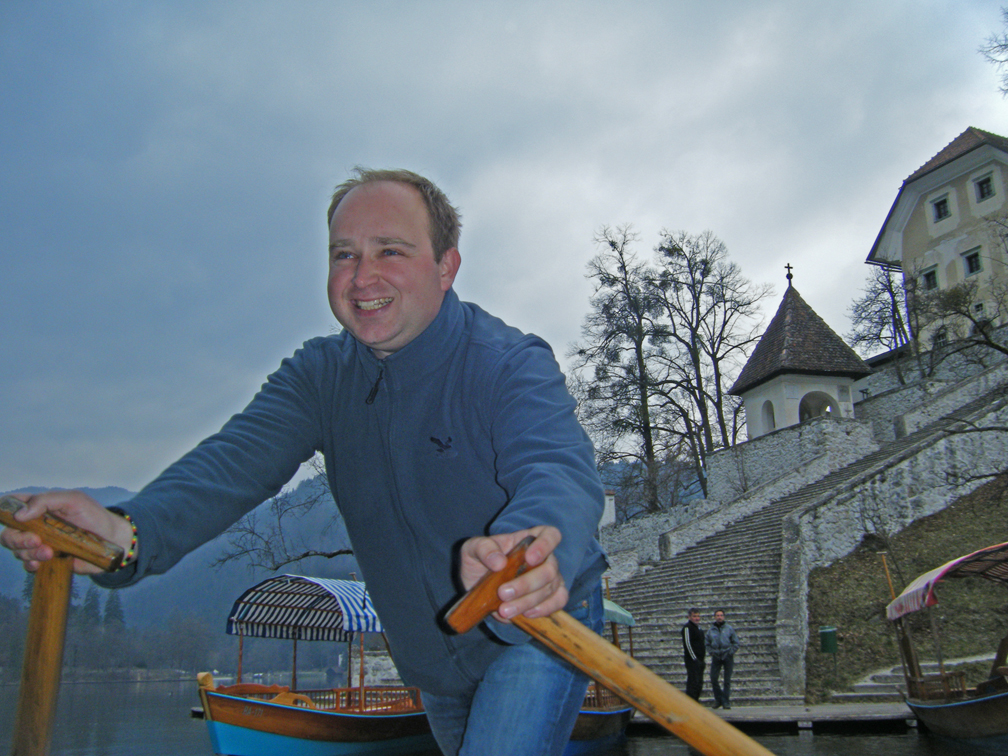
Nestled in the Julian Alps, the lake is like a scene from a fairy tale – a castle on a cliff overlooks the town, and a beautiful baroque chapel sits majestically on Slovenia’s only island.  To get to the island, you can rent a row boat or take a ride on a pletna – a special keel-less wooden boat handcrafted by local artisans and operated by local families. The pletna captains have inherited the special rights to provide this service from the time of Maria Theresa – the Hapsburg Empress who ruled Slovenia as part of the vast Austro-Hungarian Empire.  During harsh economic times, the Empress granted 20 Bled families the right to not pay taxes they could ill-afford, but instead to provide a service – transporting pilgrims across the lake to worship at the island church.  Today, the descendants of those same families continue to fulfill their ancestors’ role, but sadly, they are no longer tax exempt! 
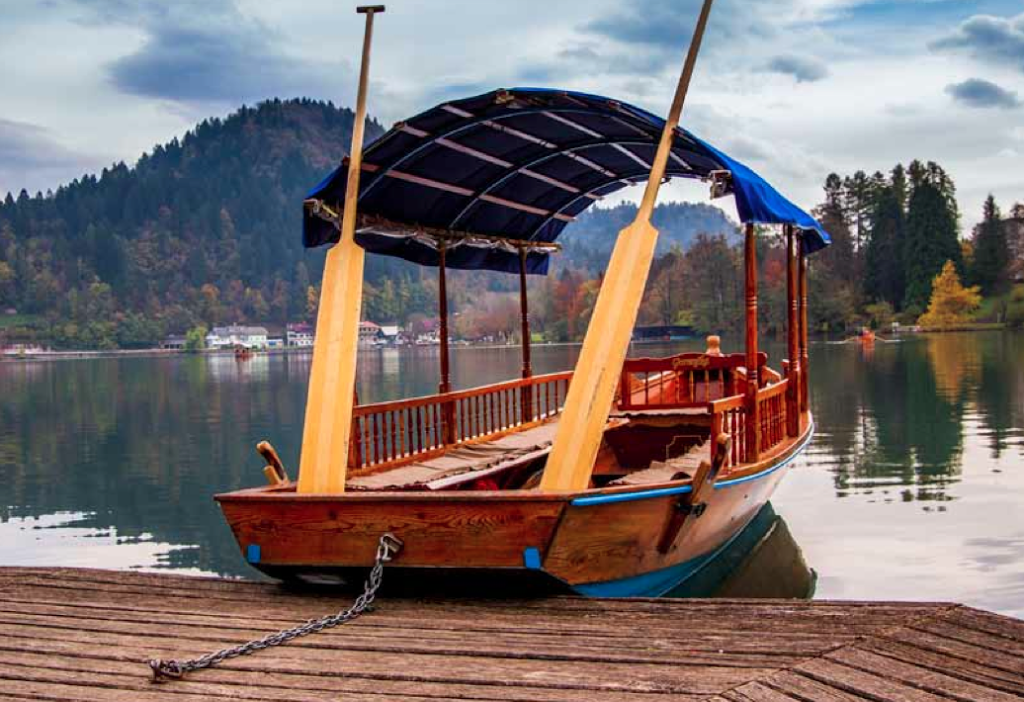
A traditional pletna, awaiting it’s next group of pilgrims.
Robert Wilfan, expert plenta captain and friendly local guide.

A journey to the island and back takes about 90 – 120 minutes (depending on how much time you spend on the island).  While you are on the island, you will be encouraged by your pletna captain to ring the “wishing bell” in the church.  Robert Wilfan, one of the pletna captains and a great local guide, loves to share the legend of the bell with tourists.  Many of the captains speak English quite well, and somehow can fit in some excellent history between deep breaths as they row and you relax!  Make sure your camera has plenty of memory – photo opportunities abound.  
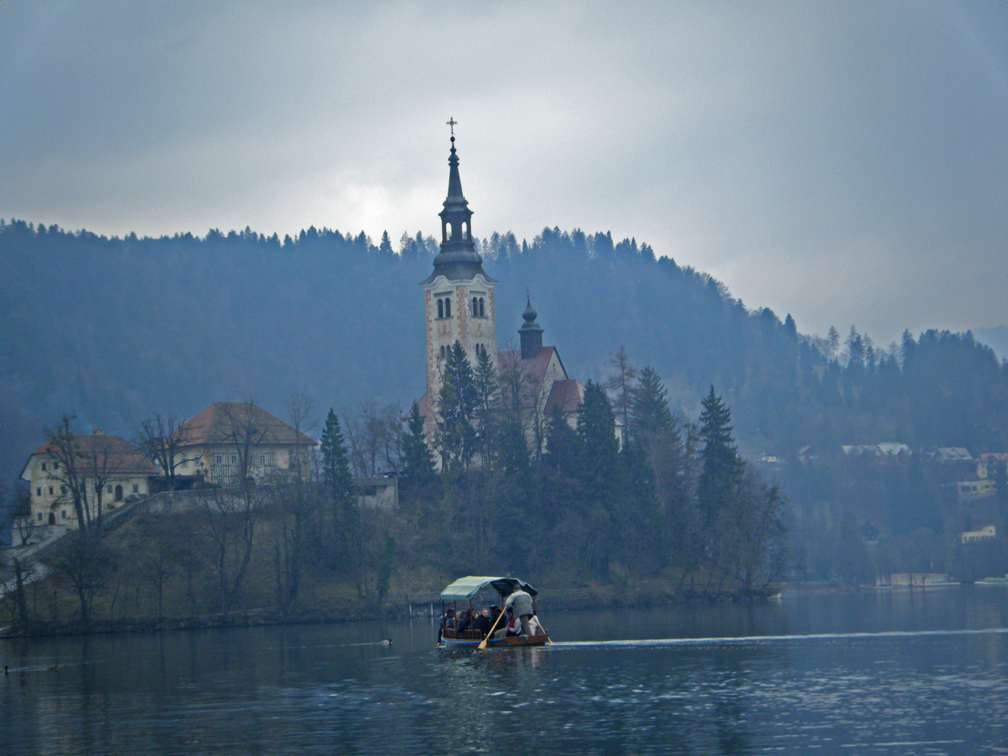
Slovenia’s only island is small, but the church is grand!
 You will get a great view of the Bled Grad (castle) that clings precariously to a lakeside cliff while you are out on the water.  Don’t miss it – when you are back in the village head up the hill to the castle (a short uphill drive in a bus or car, or a steep walk!).  Commanding views await you from the upper terrace, and a visit to the Guttenberg printing press and the monk’s wine cellar, both of which are attended by museum workers in costume and in character, are fabulous parts of the castle experience.  The monk in particular has a great sense of humour, and a great passion for Slovenian wine – which is actually really good!  I have tried several of the wines he has in his cellar, and I favour the “house” white that you can bottle yourself – with the monks help.  
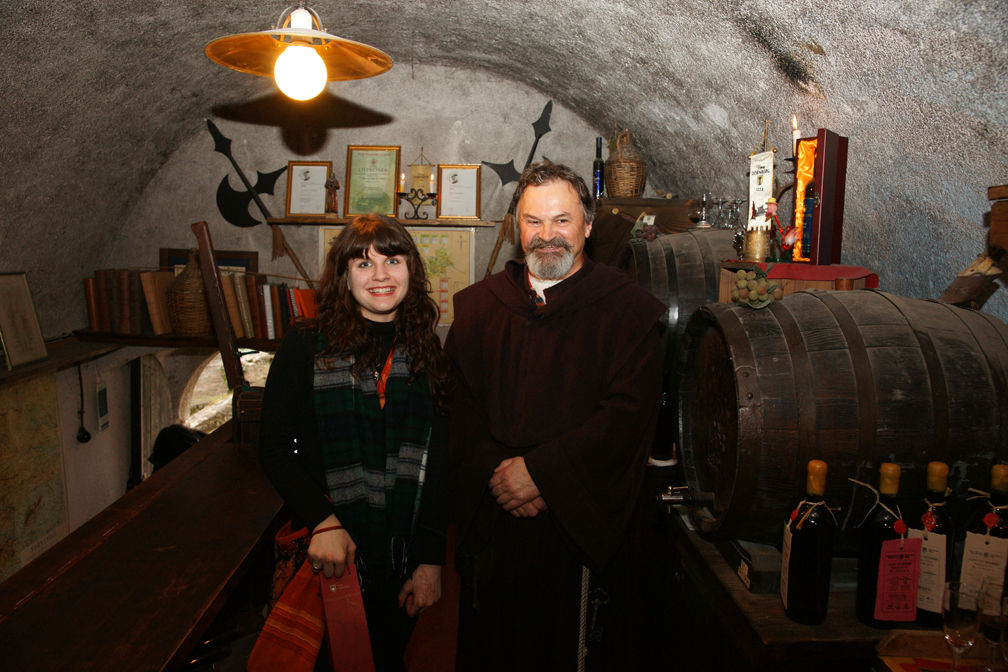
Wine is a spiritual experience for this Slovenian monk and his happy visitors!
 Back in the village, pop into a local restaurant or patisserie overlooking the lake and enjoy a piece of Kremna rezina – a Bled original.  In 1955, the pastry chef at the Park Hotel came up with a new recipe for cream cake – a mix of custard, whipped cream, and puff pastry.  Since then, they have served over 10
million of these delicious pastries!  You can go for the original at the Park Hotel, or get it at many other cafés and restaurants in town.  Afterwards, if you’re up for it, take a walk around the lake on the flat, well-maintained path – and during the hour or two it will take you, contemplate this beautiful little corner of the earth!
Interested in visiting Slovenia?  OneLife Tours Best of Eastern Europe will give you the full Lake Bled experience and more.  Check out our tours at www.onelifetours.ca
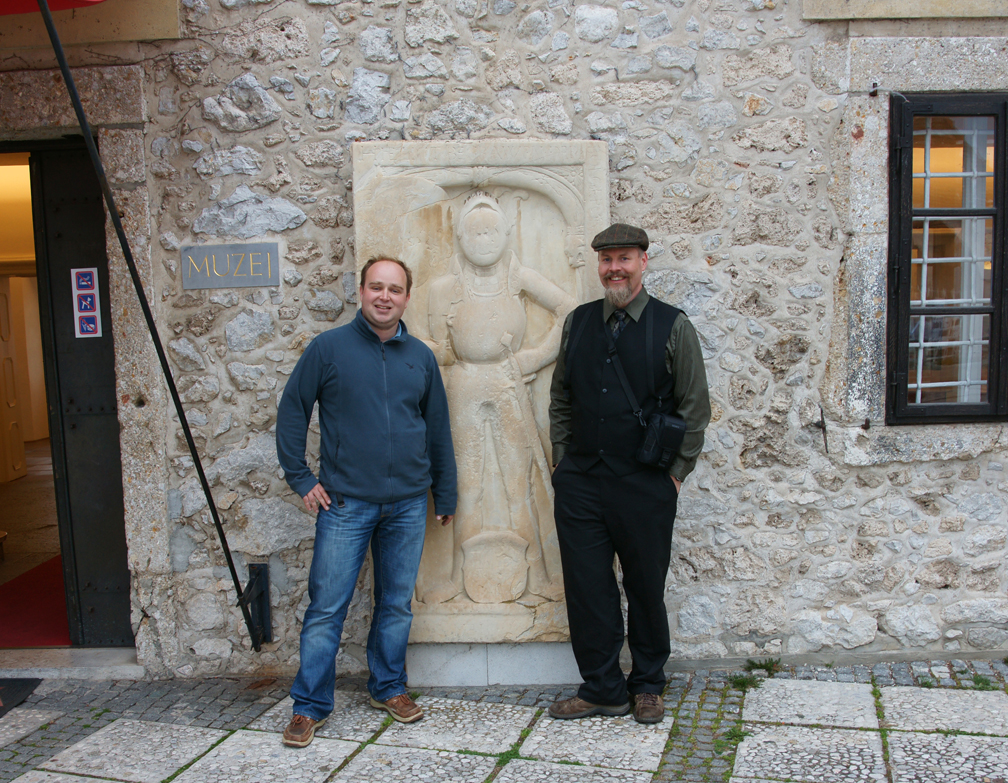
Pletna Captain Robert Wilfan and OneLife Tour Director Craig Bresett outside of the Bled castle museum.