
Archive for category: pesto

Authentic Food of the Cinque Terre

Want to try some of the best cuisine in Italy?  The food of the Cinque terre is a delight that needs to be sought out and included on any trip to the “Italian Riviera”.  In fact, the food of the Cinque Terre —including pesto genovese, minestrone and focaccia, is a favourite of many frequent travelers to Italy, including me!  Because Liguria is on the coast, seafood and fish are a big part of the diet here, and many of the region’s famous foods and recipes were first invented, or eaten, on ships or by fishermen.

Not a big seafood fan? Don’t worry! The sea breezes and mineral-rich soils mean that the region is also famous for its herbs (especially basil and rosemary), wine, olive oil, pine nuts, porcini mushrooms, and other delicious foods.

Want to make the best of your dining experience while traveling through the Cinque Terre or other parts of Liguria? Here are what food items to look for on the menu!

focaccia

Foccacia

Focaccia: Ah, focaccia! This Ligurian bread has made its way around the world, and it’s no surprise: It’s delicious either on its own, dipped in sauce, or with a spread. A flattened bread (like a pizza without tomato sauce), it’s meant to be eaten hot from the oven. It might be flavored with anything from just olive oil and salt to cheese and sausage. And it’s a street food, so don’t feel as if you have to be sitting down at a restaurant to enjoy it.

Farinata: Another Ligurian street food, farinata is a bread made from chickpea flour. As with focaccia, of course, olive oil and other flavourings (often rosemary or onion) are added in. It’s also best eaten piping-hot and fresh out of the oven.

Latte brusco: Also called “frittura di crema,” this dish involves browning parsley and onion; adding flour, milk and egg yolks; and letting it all cool and harden before dipping it in egg whites, bread crumbs, and deep-frying the whole concoction in olive oil. Eaten hot, it’s a crusty, delicious snack, especially on a cold day!

Carciofi violetti: Rome isn’t the only place famous for its artichokes. Liguria is, too—particularly Albenga. These tender-yet-crunchy artichokes pop up in sauces, pies, and frittate, and you might even see them eaten raw.

re-seafoodstew608

Ciuppin

Minestrone: Legend has it this famous soup was invented in Liguria, although, of course, we can’t be sure. But the story goes that soldiers from Genoa, serving in the First Crusade, made a meal by taking vegetables and herbs from the locals… then cooking them as a soup in their army helmets. Who knows if it’s true, but it’s certainly a fun story!

Ciuppin: Ever heard of “cioppino”? Well, that’s a dish that was developed by Italian immigrants in California in the 19th century—and it’s based on Genoa’s ciuppin. The original version, made up by fishermen on Liguria’s coast, was meant to use up the fish that were too small or damaged for anyone to buy. The fish are slow-cooked for up to two hours, making for a delicious soup. There’s also much less tomato than in the Italian-American version.

Genova_Cappon_Magro_7

Cappon Magro

Cappon magro: This dish looks like a salad… but it’s much more complicated! Hard-tack biscuits (yes, a holdover from Liguria’s seafaring times) are soaked in olive oil and salt water. They’re layered on top in a pyramid (something that takes a fair amount of artistry, and balance, to pull off!) with a mixture of fish, shellfish, olives, and eggs, and dressed with a sauce flavored with anchovies and capers. It’s a traditional dish to eat on Christmas Eve.

Corzetti: What are those funny little discs of pasta?Corzetti, of course! Coming from Genoa, they’re flat, round, and often embossed with a wooden hand-tool—something that not only gives the pasta a bit of decoration, but also lets it hold the sauce better. If you’re in Genoa, look for fresh pasta shops where they still handmake corzetti and stamp them.

Pesto Italy shutterstock_109632971

Pesto alla Genovese

Pesto alla genovese: In short, while there are lots of kinds of pesto in Italy (“pesto” can refer to any paste of herbs that’s mashed up with a mortar and pestle), pesto alla genovese is the most famous. It’s D.O.P. protected, meaning it can only be made in a very precise way, with specific ingredients (including D.O.P. basil from Genoa), to be considered the “real thing.” The ingredients themselves are simple–basil, pine nuts, Parmigiano-Reggiano, Pecorino, garlic, salt, and olive oil—and when it’s done properly, it’s absolutely delicious over penne or another pasta!

Pesto bianco: This is another kind of pesto, literally “white pesto,” that you can find in Liguria (aside from the famed pesto alla genovese!)It’s a paste of walnuts,  olive oil, and fresh ricotta.

Crema ai pinoli: Another pasta sauce from Liguria, this one is made from pine nuts, garlic, butter, and fresh marjoram. It’s especially popular in Genoa, where you’ll often see it on corzetti.

Torta pasqualina

Torta pasqualina

Torta pasqualina: If you like some pastry with your greens, you’ll love this dish. Pastry is layered with a mix of green chard, parmesan, ricotta, and other herbs, and the filling is indented with eggs and butter. The pastry layers are supposed to number 33. Sound random? Each one is for a year of Christ’s life—this dish actually got its start as an Easter tradition, although many people eat it year-round now.

Pacciugo: An ice cream that hails from the area near Portofino, pacciugo includes bitter-chocolate ice cream mixed with whipped cream, fresh fruit, cherries, and a coulis of raspberry or strawberry. It got its start in the 1930s, and became an instant hit, especially with Portofino’s many tourists.

Focaccia castelnovese: A bun made of cornmeal, olive oil, butter, and pine nuts, this is a Christmas and Easter tradition.

Ravioli dolci: Like ravioli, but not! These “sweet ravioli” are envelopes of sweet egg dough, filled with a pesto of citrus peel, candied squash, citron, and beef marrow.

Meringhi genovesi: Cake soaked in rum or another liquor, filled with apricot jam, and topped with vanilla meringue, this is a cake for tose with a serious sweet tooth!

Pandolce-génois

Pandolce

Pandolce: This literally means “sweet bread,” but it’s not what you’re thinking—it is a cake, not offal!  According to legend, the 16th-century Doge of Genoa, Andrea Doria, invited Genovese chefs to submit recipes for a food that would represent the Republic’s wealth, as well as be nutritious, durable and suitable for long sea voyages—and so pandolce was born. It’s dense, crumbly, and filled with spices and candied fruits, and it’s generally eaten only at Christmas.


Eat and Drink Like a European is dedicated to the absolute best in European travel experiences.  All of our tours feature authentic regional cuisine!  We also do travel consulting, and can help you find the places the locals eat on your independent trip to Europe.  Contact our chief tour director Craig Bresett for more information.

[author] [author_image timthumb=’on’]https://pbs.twimg.com/profile_images/506116251454697472/4blfsXiS.jpeg[/author_image] [author_info]This blog shared with you by Craig Bresett (trying not to get Farinata crumbs in my keyboard) – owner and chief tour director at Eat and Drink Like a European. Contact Craig anytime: craig@eatanddrinklikeaeuropean.com[/author_info] [/author]

5 Italian dishes you must eat in Italy


Italy is defined by its regions.  Just as you would expect the culture and cuisine of Mississippi to be different from that of Maine, you should expect that the culture and cuisine of Tuscany is different from that of Lazio or Liguria.  A smart traveller doesn’t go through Italy ordering Fettuccini Alfredo everywhere (or anywhere, for that matter – they won’t know what it is!)
Here are 5 regional dishes that you should eat in your Italian travels:

   
#5 – Baccalà alla Vicentina – Veneto

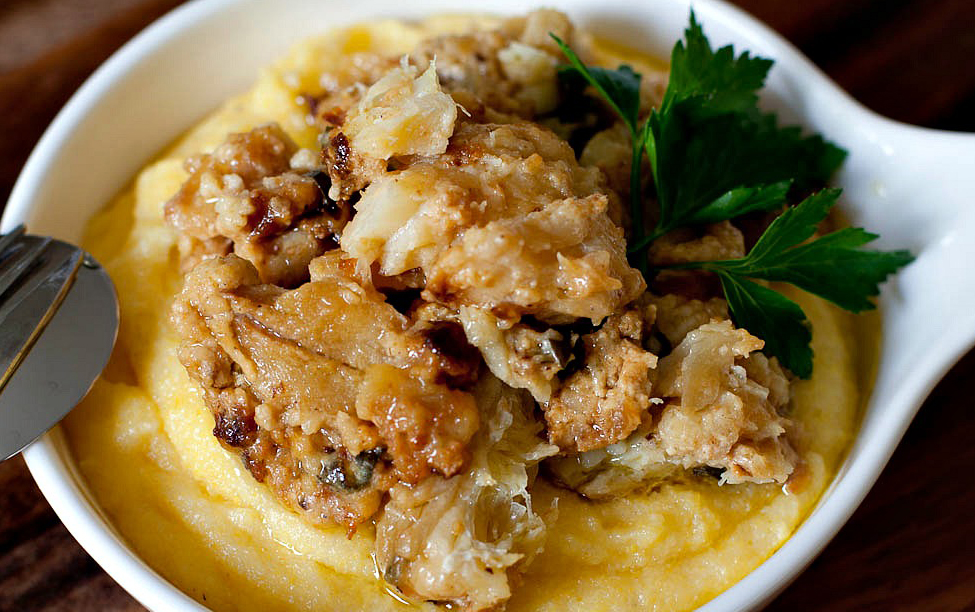
Bet you’ve never heard of this one!   Baccalà is salted or dried cod – a food that became popular in the region of Venice when Piero Querini, a travelling merchant, shipwrecked in Norway and developed a love for this high protein, easily stored food.  He brought it back to share, and it has been imported in great quantities ever since.  Served with soft polenta (a savoury cornmeal porridge popular in Northern Italy), it becomes a unique dish worth seeking out.     

Best eaten after a long day getting lost in the backstreets of Venice or Verona.


Though Baccalà officially means “salt cod” it is often dried cod which is served with this classic Veneto dish.


#4 – Tagliatelleal Tartufo – Tuscany
The truffle is one of the most prized foods in the world, and it is no surprise that it grows in Tuscany, one of the most popular foodie regions of Italy.  Truffles are mushrooms that grow underground – they are not cultivated, but must be found using specially trained pigs or dogs.  This difficulty in obtaining them, combined with their very strong flavor, make them an expensive commodity – some fetch up to $4000 per kilo!  Truffles are often used to flavor butter or oil, and can also be found thinly (VERY thinly) sliced on  Tagliatelleal Tartufo – egg noodles with truffle.  And the price won’t break your travel budget!  If it (or anything with truffle) is on the menu – try it!  
Best eaten after a day of being overwhelmed by the art and architecture of Florence.

Even sliced razor thin, truffles still pack a deluge of flavour.


#3 –  Knödel – Trentino-Alto Adige 
I can hear you now, “Knödel?  Isn’t this supposed to be a list of Italian food?  That looks German to me.”  The beautiful Trentino-Alto Adige region, more commonly known as the South Tyrol by local residents, is the northern-most region of Italy, bordering Austria, and it’s culture, cuisine, and language reflect a Germanic heritage. Knödel simply means dumpling.  And the varieties found in this region are creative, mouthwatering masterpieces of culinary art.  Try a mixed plate – one made with spinach, another with beets, another with speck (a local ham).  So good!  
 Best eaten after a day hiking in the glorious Dolomites.

Served with a broth or without, Knödel will satisfy even the heartiest of appetites.


#2 – Pizza Napoli – Lazio
Pizza is good pretty much anywhere in Italy. But when you are in Rome in the Lazio region, you must try the Pizza Napoli.  Pizza originates in Naples, south of Rome, but has spread all over the country (all over the world!).  Pizza Napoli celebrates the origins of this fisherman’s lunch – thin wheat crust, fresh tomato sauce, mozzarella cheese and anchovies.  Simple, but bursting with flavor due to the fresh sauce and the anchovies.  Don’t like anchovies?  Try the pizza Margherita – same thing but no fish.  
 Best eaten after  spending the day rummaging through the ancient past at the Roman Forum.
Your Pizza Napoli won’t be “swimming” with anchovies – just a few are enough!


#1 – Gnocchi with pesto – Liguria
Liguria is a small region on the north coast of Italy that is often referred to as the Italian Riviera. It is also the birthplace of pesto – a heavenly mixture of basil, coarse sea salt, pine nuts, garlic, extra virgin olive oil and grated Pecorino Romano cheese.  The name pesto is derived from the Italian word pestare, “to crush” – the above ingredients are tossed into a mortar and crushed together with a pestle.  A platter of warm, soft gnocchi (small potato-wheat dumplings) smothered with fresh pesto (fresh as in the basil was picked that morning) is an eating experience you will never forget.   
Best eaten after a hike anywhere in the Cinque Terre!
It’s not easy being green.  But it is so tasty!
 Interested in trying some of these dishes for yourself?  Why not join the Grand Tour of Europe, which includes great regional food like this during our eight days in Italy!  Or if you’re looking for more Italy than that – try our Italian Experience tour!
Something on this list that I’m missing?  Let me know!